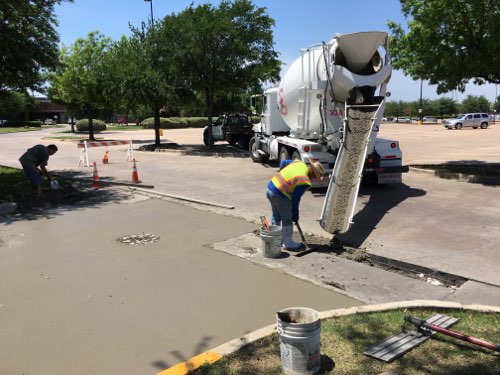
Concrete cracks are inevitable. Every concrete slab in the DFW Metroplex will develop cracks over its service life from a combination of drying shrinkage, thermal contraction, expansive clay soil movement, and live-load flexure. The critical distinction for commercial property owners and facility managers is determining which cracks are merely cosmetic and which represent structural damage that requires professional intervention. C & D Commercial Services has been diagnosing and repairing concrete cracks of every type across Dallas-Fort Worth since 1981, offering a range of repair methodologies tailored to the specific crack dynamics and performance requirements of each installation.
Our approach begins with a thorough crack assessment to classify each crack as structural or non-structural — a distinction that determines the appropriate repair strategy. Misidentifying the crack type is the most common cause of repair failure, where a rigid repair applied to a moving crack will simply break under the next seasonal expansion cycle, and a flexible repair applied to a structurally significant crack will fail to transfer loads across the joint.
Related services: Expansion Joint Installation & Sealing for Concrete, Concrete Resurfacing & Overlay in DFW, Concrete Slab Leveling.
Shrinkage Cracks. These are the most common cracks in commercial concrete flatwork. They occur during the first few weeks after placement when the concrete loses moisture faster than it can hydrate, generating internal tensile stresses that exceed the concrete’s early-age tensile strength. Shrinkage cracks are typically hairline (less than 1/16 inch wide), do not exhibit vertical displacement or offset between the two sides, and run in a roughly random pattern across the slab surface. They may intersect corners or follow the edges of aggregate particles. Shrinkage cracks are primarily a cosmetic and durability concern — they allow water infiltration that can worsen during freeze-thaw cycles, and they collect debris that detracts from appearance — but they do not affect the structural capacity of the slab.
Structural Cracks. These result from applied loads exceeding the slab’s design capacity, from sub-grade support loss due to expansive clay movement or settlement, or from reinforcing steel corrosion that generates internal expansion forces. Structural cracks are wider (typically 1/8 inch or more), often show vertical displacement (one side is higher than the other), may follow a more linear pattern or coincide with the location of reinforcing steel, and can change width seasonally as the slab expands and contracts. Structural cracks indicate that the slab is experiencing stress beyond its design limits and require engineered repair solutions to restore load-transfer capacity and prevent progressive deterioration.
C & D Commercial Services offers a tiered crack repair system based on crack classification, expected movement, and performance requirements.
Rout and Seal with Polyurea (for non-structural cracks in exterior slabs). This is our standard repair for shrinkage cracks and other non-moving cracks in parking lots, sidewalks, loading docks, and exterior flatwork. The process begins with saw-cutting a shallow channel along the crack path using a masonry blade set to a depth of 1/2 to 3/4 inch and a width of 1/4 to 3/8 inch. The channel is centered on the crack to ensure full encapsulation of the crack plane. All loose material and dust are removed from the channel using compressed air and a wire brush, followed by a vacuum pass to achieve a clean, dry surface. A two-component polyurea sealant is then injected into the channel using a pneumatic dispensing gun. Polyurea is selected for its rapid curing (traffic-ready in one to three hours depending on temperature), its exceptional adhesion to concrete, its UV stability (unlike polyurethane, it does not yellow or degrade in sunlight), and its ability to accommodate minor thermal movement without adhesive failure. The sealant is applied slightly above the surrounding surface and struck off flush with a putty knife, leaving a smooth, watertight seal that prevents water infiltration into the crack zone.
Saw-Cut Channel and Flexible Sealant (for moving cracks and joints). For cracks that are expected to continue moving due to thermal cycling, moisture-related slab curling, or ongoing sub-grade settlement, we specify a wider, deeper channel and a more flexible sealant system. The channel is cut to a depth-to-width ratio of approximately 2:1 to optimize the sealant’s elongation capacity. We install a closed-cell polyethylene backer rod at the bottom of the channel before sealant application. The backer rod serves two purposes: it prevents three-sided adhesion (which would tear the sealant under movement) and it controls the depth of the sealant to ensure the proper cross-section for the expected joint movement. A low-modulus polyurea sealant with 100% elongation capacity is applied over the backer rod. This system accommodates movement up to 25% of the joint width while maintaining a watertight seal.
Epoxy Injection (for structural cracks requiring load transfer). For structural cracks where load transfer across the crack plane must be restored — typically in warehouse floors, loading docks, and structural slabs supporting heavy equipment — we employ low-viscosity epoxy injection. This process involves drilling injection ports along the crack path at 6- to 12-inch intervals, surface-sealing the crack between ports with a rapid-set epoxy paste, and injecting a high-strength structural epoxy under pressure using a dual-cartridge dispensing system. The epoxy penetrates the full depth of the crack, restoring tensile continuity and preventing water transmission. After the epoxy has cured, the surface seal is ground flush and the area can accept traffic. Epoxy injection restores the cracked section to or near its original structural capacity, but it is only appropriate for cracks that have stabilized — active cracks must be treated with flexible sealant regardless of width.
In the DFW climate, concrete cracks that are left unsealed allow water to penetrate to the sub-grade, where it saturates the expansive clay soils common to North Texas. The saturated clay swells, exerting upward pressure on the slab that widens existing cracks and generates new ones. During the region’s occasional hard freezes, water in the crack space expands by 9% as it turns to ice, exerting tremendous tensile force against the crack walls. Over repeated freeze-thaw cycles, this process widens cracks incrementally and causes spalling at the crack edges — a self-reinforcing cycle of deterioration that can turn a minor shrinkage crack into a significant slab-edge failure requiring expensive concrete replacement.
Prompt crack sealing is the most cost-effective preventive maintenance measure available for commercial concrete flatwork. Sealing a crack with polyurea costs a fraction of what it costs to replace the slab section affected by freeze-thaw spalling. Our routine maintenance clients include crack inspection and sealing in their annual concrete maintenance scope, ensuring that cracks are addressed while they are still cosmetic issues rather than structural problems. Call C & D Commercial Services at 972.475.2271 to schedule a concrete crack assessment for your commercial property in Dallas, Fort Worth, Plano, Frisco, Irving, Arlington, or anywhere in the DFW Metroplex.
Need this service for your commercial property in DFW? C & D Commercial Services offers fast, free quotes with responses within 1 business day.