
Expansion Joint Installation & Sealing for Commercial Concrete in DFW

Expansion joints are one of the most critical yet most frequently overlooked components of commercial concrete flatwork. These planned gaps in the concrete surface serve a vital structural function: they allow the slab to expand and contract with temperature changes without generating uncontrolled cracks. In the Dallas-Fort Worth climate, where summer pavement temperatures can exceed 140 degrees Fahrenheit and winter temperatures occasionally drop below freezing, concrete expansion and contraction cycles are significant and continuous. Proper expansion joint installation and maintenance is essential for preserving the integrity and appearance of commercial parking lots, sidewalks, loading docks, and warehouse floors.

C & D Commercial Services has been installing and sealing expansion joints in DFW commercial properties since 1981. Our experienced concrete crews understand the specific joint spacing requirements, sealant material specifications, and installation techniques that produce long-lasting, low-maintenance performance in the North Texas environment. Whether you are constructing new concrete flatwork that needs properly spaced and sealed joints or maintaining existing joints that have failed and require replacement, C & D delivers professional results backed by four decades of field experience.

Related services: Concrete Crack Repair, Parking Garage Concrete Deck Repair in DFW, Concrete Sub-Base Stabilization for Expansive Clay Soils.
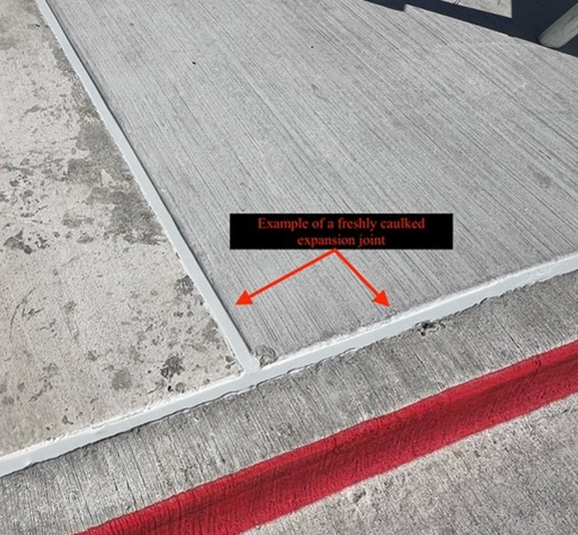
Close-up of a freshly caulked concrete expansion joint on a commercial sidewalk, showing professional grey sealant application.

Proper Joint Spacing Guidelines for Commercial Concrete

The American Concrete Institute (ACI) provides generally accepted guidelines for joint spacing based on slab thickness and aggregate size, but local practice in the DFW market incorporates additional conservatism to account for the extreme temperature swings and expansive clay sub-grade conditions common to North Texas.

Parking Lots and Drive Lanes. For standard 6-inch-thick reinforced concrete parking lot slabs, we recommend expansion joints (also called isolation joints) at all points where the slab meets a fixed object — building foundations, column footings, light pole bases, catch basins, and curb returns. Contraction joints (control joints) should be placed at spacing of 12 to 15 feet in each direction, creating square panels that concentrate cracking along the saw-cut line rather than allowing random cracking across the slab surface. In DFW’s climate, we consider 15 feet the absolute maximum joint spacing for parking lot concrete; for slabs on expansive clay sub-grade, we recommend tightening to 12 feet to reduce the stress per panel.

Sidewalks and Pedestrian Walkways. The standard joint spacing for 4-inch-thick residential and light-commercial sidewalks is 5 feet, but for heavy-traffic commercial walkways with 5- to 6-inch thickness, we recommend control joints at 6 to 8 feet. This tighter spacing is particularly important for walkways adjacent to building foundations, where differential movement between the slab and the structure is most pronounced. Isolation joints must be installed wherever the walkway abuts a building foundation, retaining wall, curb, or other fixed structure to prevent the walkway slab from transmitting movement forces into the structure.

Loading Docks and Industrial Floors. Heavy-duty industrial slabs, typically 6 to 8 inches thick with welded wire fabric or rebar reinforcement, should have control joints at 12 to 15 feet in each direction. Loading docks that experience daily forklift and heavy truck traffic benefit from armored joints with steel angle-iron edging at the dock edge to prevent the corner spalling that occurs when the joint sealant fails and incompressible materials accumulate in the joint space.

Formed Joints vs. Saw-Cut Joints

C & D installs expansion and contraction joints using two methods, each appropriate for different applications:

Formed Joints. Formed joints are created by placing pre-formed joint material (typically 1/2-inch-thick asphalt-impregnated fiberboard or closed-cell polyethylene foam) into the concrete formwork before the pour. When the concrete is placed and finished, the joint material remains in place, creating a continuous separation between adjacent slab sections or between the slab and an abutting structure. Formed joints are preferred for isolation joints at building perimeters, around columns, and wherever the joint must accommodate significant differential movement. The formed joint gasket is typically installed flush with the finished concrete surface, or slightly below grade to allow for sealant application.

Saw-Cut Joints. Saw-cut joints (contraction joints) are created by cutting a groove into the surface of the concrete after it has hardened sufficiently to support the weight of the saw without ravelling the aggregate — typically 4 to 12 hours after finishing, depending on temperature and mix design. Saw-cutting induces a plane of weakness that directs shrinkage cracking to the bottom of the saw cut, where the crack is invisible from the surface and protected from water intrusion by the sealant. Saw-cut joints are typically cut to a depth of 1/4 to 1/3 of the slab thickness using walk-behind masonry saws with diamond blades for green concrete or abrasive blades for cured concrete. Timing is critical: cut too early and the saw ravels the joint edges; cut too late and uncontrolled cracking may occur before the saw reaches the joint location.

Resealing Failed Expansion Joints

Over time, expansion joint sealants fail from UV exposure, thermal cycling, adhesive bond loss, oxidation, and physical damage from traffic and debris accumulation. Failed joints allow water to penetrate to the sub-base, incompressible materials (sand, gravel, trash) to accumulate in the joint space, and eventually cause slab-edge spalling as the slab expands against the trapped debris. When joints fail, removing the old sealant and replacing it with a modern polyurea system restores the joint’s protective function.

C & D’s joint resealing process follows a systematic protocol:

1. Old Sealant Removal. Existing failed sealant is removed using a combination of mechanical routing (saw-cut or rotary brush tool) and hand tools. For polyurethane and silicone sealants that have strongly bonded to the joint walls, we use a specialized hot-air lance that softens the sealant without damaging the concrete, followed by mechanical extraction. Asphalt-impregnated fiberboard joint filler that has degraded is removed with pneumatic chisels working carefully to avoid spalling the joint edges.

2. Joint Cleaning. After the old sealant is removed, the joint walls and base are cleaned using wire brushes, compressed air, and industrial vacuum equipment. Any residual sealant, dust, dirt, or laitance on the joint walls will prevent proper adhesion of the new sealant. For joints with oil or grease contamination (common in parking lot joints), we use a biodegradable degreasing agent followed by high-pressure water rinsing and thorough drying.

3. Backer Rod Installation. A closed-cell polyethylene backer rod is installed at the proper depth in the joint. The backer rod diameter should be approximately 25% larger than the joint width to ensure a snug friction fit. Proper depth control is essential: the sealant must have a minimum depth of 1/4 inch and a maximum depth of 1/2 inch for typical 3/8-inch-wide joints, with a depth-to-width ratio not exceeding 2:1.

4. Primer Application. For concrete substrates in high-moisture or high-traffic environments, we apply a primer to the joint walls before sealant installation. The primer improves adhesion and prevents the sealant from bonding to the backer rod.

5. Polyurea Sealant Installation. A two-component polyurea sealant is installed using a pneumatic dispensing gun with a static mixing nozzle. The sealant is applied starting at the bottom of the joint (over the backer rod) and filling upward to ensure no air pockets are trapped. The sealant is struck off slightly concave to allow for expansion without bulging above the surface.

Call C & D Commercial Services at 972.475.2271 to schedule a joint inspection and receive a comprehensive recommendation and quote for expansion joint installation or resealing on your Dallas-Fort Worth commercial property.

Explore our full range of concrete construction and masonry services, commercial maintenance services.

Get a Free Quote

Need this service for your commercial property in DFW? C & D Commercial Services offers fast, free quotes with responses within 1 business day.


    © Copyright 2025 C and D Commercial Services, Inc.