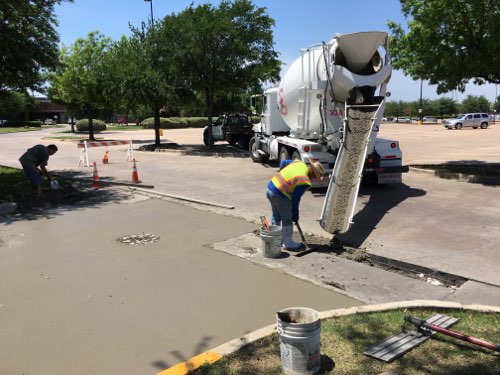
Commercial concrete slabs that are structurally sound but show surface wear — spalling, scaling, pop-outs, surface cracking, and general abrasion — do not need full replacement. C & D Commercial Services offers thin bonded concrete overlay and resurfacing systems that restore a like-new appearance and extend the service life of sound slabs by 10 to 15 years at a fraction of the cost of demolition and re-pour. For commercial properties across Dallas-Fort Worth, resurfacing is the cost-effective solution for parking lots, loading docks, building entrances, warehouse floors, and pedestrian walkways where the substrate remains structurally competent but the wear surface has deteriorated.
Our overlay systems range from 1-inch to 2-inch thicknesses and are bonded to the existing slab using a combination of mechanical surface preparation and polymer-modified cementitious bonding agents. The result is a monolithic wearing surface that performs as an integral part of the existing slab, not a separate layer that can delaminate over time.
Related services: Concrete Crack Repair, Parking Garage Concrete Deck Repair in DFW, Expansion Joint Installation & Sealing for Concrete.
The decision between resurfacing and replacement depends on the condition of the existing concrete substrate, not just the severity of surface wear. A slab that exhibits widespread structural cracking, advanced reinforcing steel corrosion, sub-base failure from expansive clay, or severe freeze-thaw damage throughout its full depth is a candidate for replacement. But a slab that is structurally intact — with only the top 1/8 to 1/4 inch showing wear, scaling, or carbonation — can be restored to superior condition through resurfacing with significant cost savings.
Typical cost comparisons in the DFW market show that thin bonded overlays cost 40 to 60% less than full slab replacement, depending on the size of the area and the complexity of the surface preparation required. Additionally, resurfacing generates dramatically less waste (no concrete to haul to the landfill), can be completed in less time (most parking lot overlays are finished in one continuous weekend), and eliminates the need to manage sub-base stabilization, rebar installation, and extended curing periods associated with new pours.
C & D’s thin bonded overlay system is installed through a carefully controlled multi-step process that has been refined over decades of DFW commercial concrete projects:
Surface Preparation. The single most important factor in overlay success is the bond between the new material and the existing slab. We use ride-on shotblasting equipment to remove the top 1/16 to 1/8 inch of deteriorated surface paste, expose fine aggregate for mechanical interlock, and create a uniform surface profile. Shotblasting is preferred over grinding or acid etching because it simultaneously cleans the surface, provides consistent texture, and does not leave chemical residues that could interfere with bonding. All cracks wider than hairline are routed and sealed with flexible polyurea before the overlay is applied to prevent reflective cracking.
Bonding Agent Application. Within two hours of shotblasting and immediately before overlay placement, we apply a heavy coat of polymer-modified cementitious bonding grout. This material is brushed or squeegeed into the prepared surface to fill microscopic porosity and create a chemical bond between the old concrete and the new overlay. The bonding agent must remain wet-to-the-touch when the overlay is placed — if it dries, bond strength is compromised, and our workmanship warranty requires immediate removal and re-application.
Overlay Placement. Our polymer-modified cementitious overlay is mixed in continuous-feed volumetric mixers on-site to ensure consistent water-cement ratio and workability. The material is placed at the specified thickness (typically 1 to 2 inches), struck off with a laser-guided screed to control elevation and slope, and finished with a combination of bull-floating and power-troweling to achieve the requested surface texture — broom finish for parking lots and loading docks, smooth trowel finish for interior warehouse floors, or exposed aggregate for architectural pedestrian zones.
Curing and Jointing. The overlay must be kept moist for a minimum of 72 hours using wet-curing with burlap and polyethylene sheeting, or sprayed with a membrane-forming curing compound. After the initial cure period, joints are saw-cut to match the original slab’s joint pattern (typically within 24 hours of the pour to prevent uncontrolled cracking from thermal contraction). Joints are then sealed with flexible polyurea sealant to prevent water intrusion and incompressible material accumulation.
Thin bonded overlays are suitable for a wide range of commercial applications across DFW properties:
Parking Lots. Commercial parking lots experience constant tire abrasion, oil and fluid drips, deicing chemical exposure, and weathering. When the surface begins to scale or spall but the slab structure is sound, a 1.5-inch bonded overlay restores a clean, professional appearance and improves skid resistance. Overlays can be color-integrated to create defined parking zones, fire lanes, or ADA-accessible routes.
Loading Docks. Loading dock slabs face concentrated impact loads from pallet jacks, forklifts, and heavy truck tires that cause surface wear in high-traffic zones. A polymer-fortified overlay restores the surface to a smooth, cleanable condition while maintaining the structural capacity to handle heavy industrial traffic. Overlays for loading docks are specified with enhanced aggregate content for superior impact resistance.
Building Entrances and Walkways. High-visibility entrance slabs and pedestrian pathways that show surface wear detract from curb appeal and tenant satisfaction. A thin overlay with an architectural finish — exposed aggregate, stamped pattern, or colored integrally — can transform a worn entrance into a distinctive design feature that reinforces your property’s brand identity. These overlays can be installed with slip-resistant finishes that meet ADA requirements.
Warehouse Floors. Interior warehouse floors subjected to heavy rack loading, forklift traffic, and concrete dusting can be restored with a high-density overlay that densifies and hardens the surface. These overlays are specified with low water-cement ratios and densifying hardeners that produce an abrasion-resistant, dust-free surface capable of supporting heavy industrial loads.
Since 1981, C & D Commercial Services has completed hundreds of concrete resurfacing projects across the Dallas-Fort Worth Metroplex. Our experienced overlay crews are trained in the specific requirements of bonded concrete systems — surface preparation timing, bonding agent application, material temperature management, and joint restoration — that determine whether an overlay performs for 10 years or delaminates in the first seasonal cycle. We stand behind our work with a comprehensive warranty covering material and workmanship defects. Call 972.475.2271 to schedule an overlay assessment for your DFW commercial property.
Need this service for your commercial property in DFW? C & D Commercial Services offers fast, free quotes with responses within 1 business day.