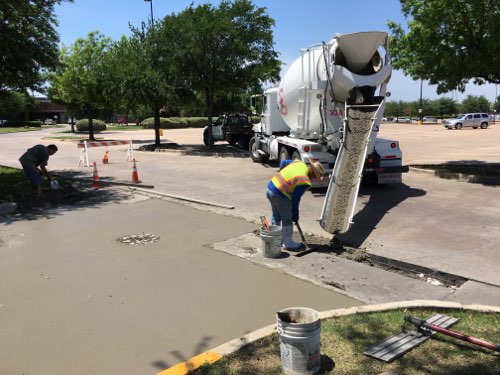
The Dallas-Fort Worth Metroplex is built atop one of the most challenging soil formations in the United States — the Eagle Ford Shale and Austin Chalk formations that produce highly expansive clay soils. These soils can swell by 30% or more when saturated with water and shrink dramatically during the region’s frequent drought periods, generating enough force to lift, crack, and displace concrete slabs that were poured on untreated native soil. C & D Commercial Services specializes in concrete sub-base stabilization — a engineered solution that addresses slab failures at their source by removing problematic soil and replacing it with compacted select fill materials designed to resist moisture-induced volume change.
For commercial property owners and facility managers in DFW, sub-base stabilization is not a preventive luxury — it is the only permanent solution for recurring slab settlement, cracking, and differential movement caused by expansive clay. Surface-level repairs such as crack filling or mud jacking treat the symptoms but not the underlying cause; within one or two seasonal cycles, the same movement patterns reappear as the clay rehydrates and expands against the repaired slab. Proper sub-base stabilization breaks this cycle permanently.
Related services: Concrete Gutter & Drainage Repair, Loading Dock Apron Concrete Repair, Concrete Slab Leveling.
Expansive clay soils common to North Texas contain microscopic plate-shaped clay particles called smectite and montmorillonite. When dry, these particles lie flat in a tightly packed arrangement. When moisture is introduced, water molecules penetrate between the plates, forcing them apart and causing the soil mass to swell. The swelling pressure generated by hydrated clay can exceed 10,000 pounds per square foot — more than enough to lift a 6-inch concrete slab reinforced with #4 rebar on 18-inch centers.
The problem is amplified in DFW by the region’s weather patterns — intense spring rains followed by long summer droughts create repeated wet-dry cycles that cause slabs to heave and settle cyclically. Each cycle fatigues the concrete and reinforcement until cracking becomes inevitable. Slabs poured directly on native clay without sub-base treatment typically show distress within three to five years in the DFW market, whereas properly stabilized slabs can perform without structural issues for 25 years or more.
C & D’s concrete sub-base stabilization is always performed in conjunction with slab replacement — there is no way to treat the soil beneath a slab without removing the concrete first. Our process follows a methodical sequence that has been refined over four decades of DFW commercial concrete work:
1. Slab Removal and Site Access. We saw-cut and remove the distressed concrete slab, stockpiling the material for recycling if no rebar contamination exists. The excavation area is expanded 12 to 18 inches beyond the slab footprint to provide working room for compaction equipment and to ensure that the stabilized zone extends beyond the slab edges where moisture intrusion most commonly occurs.
2. Problematic Soil Excavation. Using excavators equipped with hydraulic thumbs for precision work adjacent to existing structures, our crews remove 12 to 24 inches of native clay soil from the entire slab footprint. The depth of removal is determined by on-site soil observations and our experience with the specific property’s geology — areas with deep clay formations or prior water intrusion history receive deeper removal.
3. Drainage System Installation. Before any fill material is placed, we install perimeter drainage systems as needed. These typically consist of perforated 4-inch schedule-40 PVC pipe in gravel trenches, wrapped in filter fabric, and sloped to daylight or to a positive outlet. Drainage is critical because sub-base stabilization fails if moisture can re-enter the treated zone from the sides or below; controlling water at the perimeter is as important as what we place beneath the slab.
4. Geotextile Fabric Placement. A layer of non-woven geotextile separation fabric is placed at the bottom of the excavation. This fabric performs two essential functions: it prevents the select fill from mixing with the underlying native soil (which would reintroduce clay contamination over time), and it provides lateral drainage for any moisture that migrates upward, directing it toward the perimeter drains.
5. Select Fill Placement and Compaction. We import and place select granular fill material — typically crushed limestone or stabilized sand with a plasticity index of 6 or less — in 6-inch loose lifts. Each lift is compacted to 95% Standard Proctor density using vibratory plate compactors for confined areas and smooth-drum rollers for open areas. Moisture content is tested throughout the compaction process to ensure the fill is at or near optimum moisture, preventing future settlement.
6. Slab Replacement. Once the stabilized sub-base has passed compaction testing, we pour a new reinforced concrete slab per the project specifications, using 4,000-psi concrete with air entrainment for freeze-thaw resistance, fiber mesh, and welded wire fabric or rebar as required by the structural loading.
Not every concrete slab failure in DFW requires full sub-base stabilization. Minor cracking from shrinkage or light loading can be addressed with crack repair or resurfacing. However, sub-base stabilization is indicated when you observe any of the following:
- Differential slab settlement exceeding 1/2 inch across a 10-foot span.
- Slab edges that are visibly lower than adjacent landscape or pavement.
- Recurring cracking in the same location after prior repairs.
- Ponding water on or adjacent to the slab during rain events.
- Interior slab movement in buildings without deep foundation systems.
- Cracks wider than 1/4 inch with vertical displacement between sides.
If your property exhibits these signs, call C & D Commercial Services at 972.475.2271 for a site evaluation. Our concrete team will perform a visual assessment, probe the sub-base to determine soil conditions, and provide a stabilization recommendation with a firm, all-inclusive price. Serving all of DFW including Dallas, Fort Worth, Plano, Frisco, Irving, Arlington, Garland, and Mesquite.
Need this service for your commercial property in DFW? C & D Commercial Services offers fast, free quotes with responses within 1 business day.